Execution knife
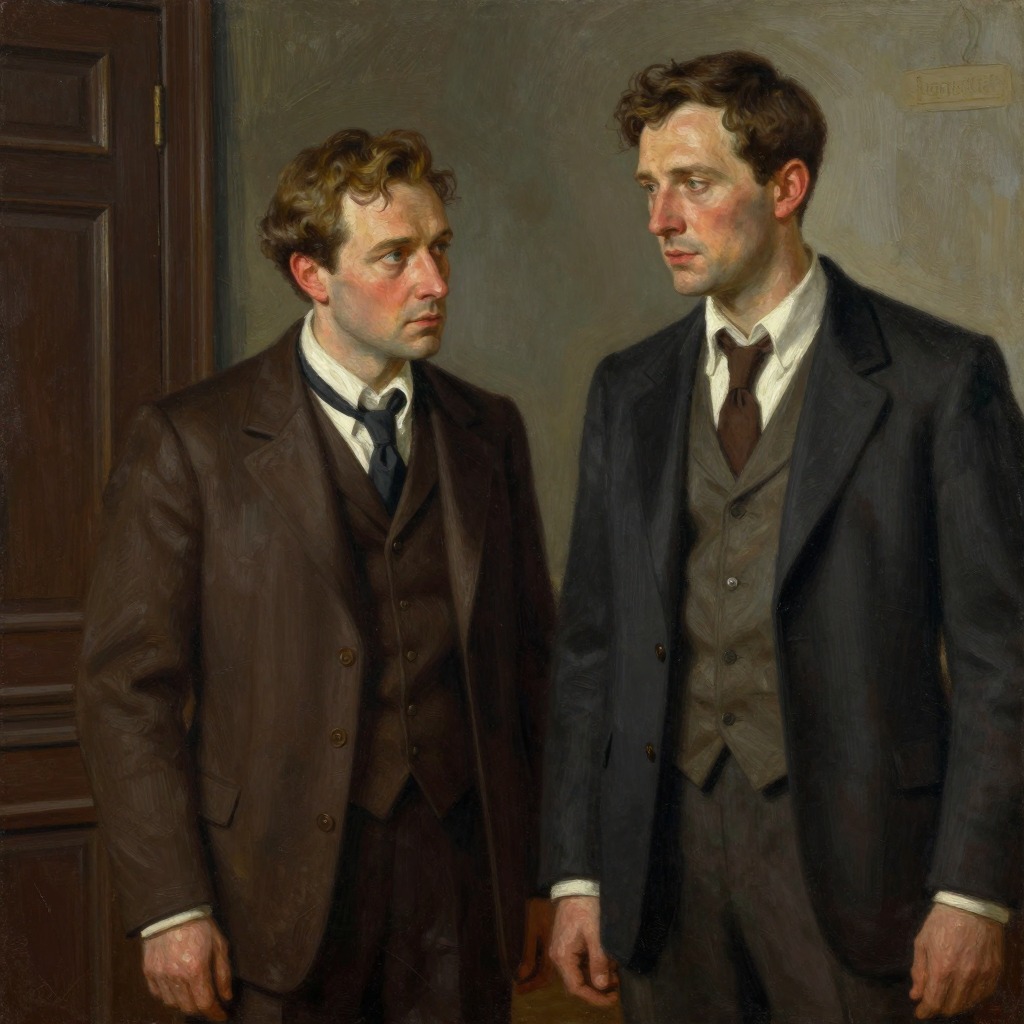
The execution knife appears in the novel's final scene, when two men in frock coats come for Josef K. on the evening before his thirty-first birthday. One of them opens his frock coat and from a sheath hanging on a belt stretched across his waistcoat withdraws a long, thin, double-edged butcher's knife, which he holds up in the light to test its sharpness. The two men then engage in what K. perceives as repulsive courtesies, passing the knife over K. from one to the other and back again, as if inviting him to take it and thrust it into himself. K. does not do so, and the men ultimately carry out the execution themselves: one lays his hands on K.'s throat while the other pushes the knife deep into his heart and twists it twice. As his eyesight fails, K. sees the two men cheek by cheek, close in front of his face, watching the result, and his last words are "Like a dog!" — the shame of it, he feels, should outlive him.
Appearance and Context
The knife is introduced without any prior description or foreshadowing in the novel's main narrative. It is simply produced from its sheath at the quarry, a place that is empty and abandoned, near a building still like those in the city. The moonlight lies everywhere with a natural peace granted to no other light. The weapon's sudden materialization, in a setting of stark emptiness, gives it an almost ceremonial quality, as if it were an official instrument of the court that has been kept hidden until the moment of its use. The knife is a butcher's knife, a tool associated with the slaughter of animals, and its double-edged blade suggests a purpose that is both practical and final.
The Ritual of the Knife
The passing of the knife over K. between the two men constitutes a macabre ritual. K. knows it would be his duty to take the knife and thrust it into himself, but he does not do it. Instead, he twists his neck, which is still free, and looks around. He is not able to show his full worth, not able to take all the work from the official bodies, and he lacks the rest of the strength he needs — this final shortcoming, he reflects, is the fault of whoever had denied it to him. The knife thus becomes the focal point of a failed transfer of agency: the court's representatives offer K. the chance to perform his own execution, and his refusal to do so marks his final defeat. The knife is not merely a weapon but a test, and K. fails it.
The Knife and the Court's Violence
The knife is the only physical instrument of violence that the court ever deploys directly against K. Throughout the novel, the court's power is exercised through arrest, interrogation, psychological pressure, and the threat of an invisible legal apparatus. The whip-man scene, in which Franz and Willem are beaten, shows the court's capacity for corporal punishment, but that violence is directed at subordinate officials, not at the accused. The execution knife, by contrast, is reserved for the final act, and its use is carried out by the two men who are described as "some ancient, unimportant actors" — figures who seem to K. like tenors, with big double chins and faces whose cleanliness disgusts him. The knife thus becomes the instrument through which the court's abstract, bureaucratic power is translated into a single, irreversible physical act.
The Knife and the Theme of Self-Judgment
The knife's role in the execution scene connects to the novel's broader theme of the accused's responsibility for his own judgment. The court, as the prison chaplain tells K., "doesn't want anything from you. It accepts you when you come and it lets you go when you leave." The knife, offered to K. for self-stabbing, literalizes this idea: the court provides the means, but the act must be performed by the accused himself. K.'s failure to take the knife and use it on himself is the culmination of his inability throughout the trial to take decisive action, to confess, or to accept the court's authority on its own terms. The knife, in this sense, is not just a weapon but a symbol of the judgment that K. cannot bring himself to pronounce on himself.